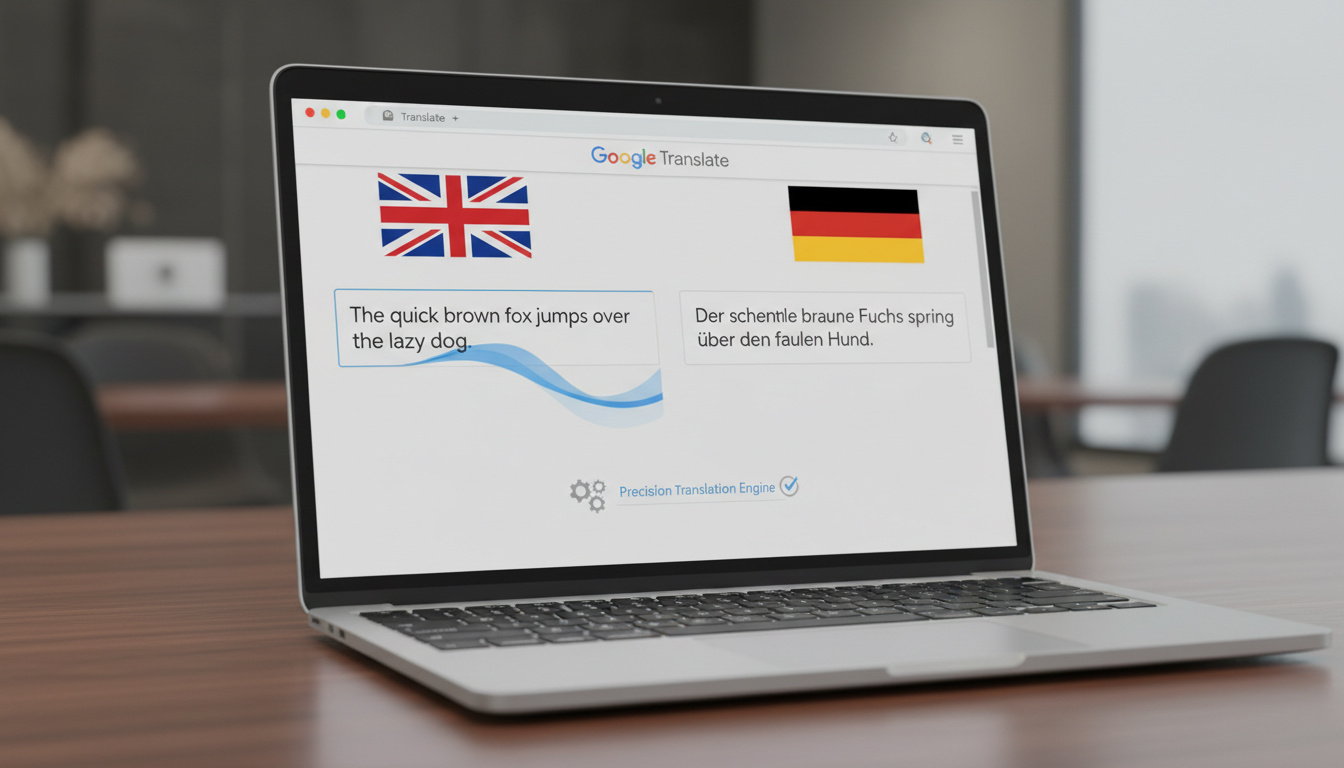
Google Translate processes billions of daily translations between English and German using neural machine translation technology, offering instant text conversion, voice recognition, and offline capabilities across web browsers and mobile applications.
Accessing the service requires no account for basic text conversion. Users navigate to translate.google.com or install the mobile application from Google Play or the App Store. The platform supports over 249 languages as of February 2025, with the English-German pair benefiting from specialized neural network training.
Accuracy varies significantly based on content complexity. While the system handles straightforward vocabulary with high speed, independent benchmarks reveal limitations when processing idiomatic expressions or cultural nuances.
How Do I Use Google Translate from English to German?
- Access Points: Web interface, iOS/Android native apps
- Language Coverage: 249+ total languages with dedicated EN-DE neural models
- Cost Structure: Free consumer tier with Cloud Translation API for developers
- Core Technology: Neural Machine Translation with PaLM 2 integration
- Neural shift: Migration to GNMT in 2016 improved contextual accuracy by mimicking brain-like pattern recognition
- Benchmark performance: UCLA 2021 study documented 82.5% meaning preservation across all languages
- Accuracy variance: English-German pairs perform stronger than low-resource languages but remain inconsistent
- Offline capability: German language packs available among 59 offline-supported languages
- Processing volume: System handles billions of daily translations at unprecedented speeds
- Competitive comparison: DeepL demonstrates 1.3x higher accuracy in blind testing for European language pairs
- Use case recommendation: Optimal for casual communication requiring human review for professional publication
| Feature | English-German Support | Operational Notes |
|---|---|---|
| Text Translation | Yes | Real-time character-by-character processing |
| Document Upload | Yes | Supports .docx, .pdf with formatting preservation |
| Voice Input | Yes | Speech-to-text with conversation mode |
| Offline Mode | Yes | Requires prior download of German language pack |
| Website Translation | Yes | URL input or Chrome extension integration |
| Camera Translation | Yes | Real-time image scanning; functional offline |
| Conversation Mode | Yes | Online only; disabled in offline configuration |
| Handwriting Input | Yes | Character drawing interface for complex scripts |
Is Google Translate Accurate for English to German?
What Do Independent Benchmarks Reveal?
Research from Smartling indicates Google Translate achieves 82.5% meaning preservation overall according to a 2021 UCLA study. However, accuracy fluctuates between 55% and 94% depending on the specific language pair. English-German translation performs within the upper quartile but exhibits inconsistency with complex sentence structures.
Neural Machine Translation models excel in producing fluent surface-level text. The system analyzes vast bilingual datasets to predict contextual word relationships. Yet this statistical approach falters when encountering idiomatic expressions requiring cultural knowledge rather than linguistic pattern matching.
Where Do Common Errors Emerge?
Round-trip translation tests expose significant drift. When researchers translate text from English to German and back to English, meaning alterations occur frequently. Specific failure points include sentence boundary detection in voice input and incorrect handling of formal address forms like “Entschuldigen Sie,” which may render as “to apologize” rather than “Excuse me.”
Recent app updates have introduced mid-sentence cutoffs during voice processing, compounding parsing errors. Users report particularly unreliable results with regional slang and industry-specific terminology.
The platform remains unsuitable for certified document translation, legal contracts, or medical instructions without expert post-editing. Neural networks lack the contextual awareness to navigate liability implications or cultural sensitivities inherent in professional German business communication.
How to Translate Documents, Websites, and More from English to German
Handling Complex Documents and Web Content
Document translation supports batch processing of .docx and .pdf files while attempting to preserve original formatting. Users upload files directly through the web interface or mobile application. For websites, inputting a URL generates a fully translated version accessible through the browser, though dynamic content may require manual refresh.
Cloud Translation API integration allows developers to embed English-to-German capabilities directly into third-party applications and services. This enterprise functionality extends beyond the consumer interface, though pricing and usage limits apply differently than the free tier.
Voice Input and Offline Accessibility
Voice translation requires tapping the microphone icon for speech-to-text conversion. The conversation mode facilitates bilingual dialogue but demands continuous internet connectivity. Offline functionality requires navigating to Menu > Offline translation > Download German pack before disconnecting.
Camera translation functions without connectivity for downloaded language pairs, though image recognition accuracy may degrade. The “Tap to Translate” feature generates in-app popups when copying text on mobile devices.
Download the German language pack before traveling. Verify sufficient storage space; packs typically require several hundred megabytes. Test camera functionality offline as image rendering may scramble without server support.
Conversation mode disables entirely without internet access. Speak slowly to reduce sentence boundary errors. Enable pronunciation practice through audio playback to verify German phonetic output.
How Has English-German Translation Technology Evolved?
- : Google Translate launches utilizing statistical machine translation methods
- : Neural Machine Translation (GNMT) replaces statistical engines, dramatically improving English-German contextual accuracy
- : Conversation mode expansion enables real-time bilingual dialogue processing
- : PaLM 2 integration introduces advanced linguistic fluency models
- : Platform reaches 249+ supported languages with optimized English-German neural pathways
What Is Certain vs. Uncertain About Translation Quality?
Established Capabilities
- Processes billions of translations daily at high velocity
- Achieves 82.5% meaning preservation in controlled tests
- Operates on neural networks mimicking human cognitive patterns
- Supports 59 languages including German in offline mode
- Provides free access to core text, voice, and image translation
Unresolved Limitations
- Consistency of idiomatic expression handling across contexts
- Reliability of cultural nuance preservation in professional settings
- Accuracy variance when processing regional German dialects
- Long-term contextual coherence in extended document translations
- Validation requirements for legally or medically sensitive content
Why Does Accessible English-German Translation Matter?
The English-German language pair facilitates significant economic and academic exchange. Anne Hathaway (Wife of Shakespeare) represents historical linguistic evolution, much as modern tools accelerate contemporary cross-cultural communication. Immediate translation capability reduces barriers for travelers, students, and businesses operating between Anglophone and German-speaking regions.
Neural machine translation democratizes access to information previously requiring specialized linguistic training. However, the technology functions most effectively as an aid rather than replacement for human expertise, particularly in scenarios requiring emotional intelligence or subject-matter precision. Neural machine translation democratizes access to information previously requiring specialized linguistic training, and you can find more information about this topic at John 3.
What Do Experts Say About Machine Translation?
Neural Machine Translation marked a fundamental shift from statistical methods, enabling contextual accuracy by mimicking brain-like neural networks trained on vast bilingual datasets.
— Smartling Comparative Analysis
Round-trip translation tests reveal meaning drift when converting German back to English, particularly with sentences containing multiple clauses or cultural references.
— Ehlion Translation Technology Review
While Google Translate demonstrates superior versatility and scale, DeepL achieves 1.3x higher accuracy in blind testing for European language pairs including English-German.
— UCLA 2021 Study via Smartling
What Is the Bottom Line for English-German Translation?
Google Translate serves as a reliable first-layer tool for English-German conversion, excelling in speed and accessibility while requiring human verification for professional contexts. Users seeking superior nuance should consider Harry Potter and the Half-Blood Prince as an example of complex text where cultural context proves critical—similar to how idiomatic German demands careful interpretation beyond literal word substitution.
Frequently Asked Questions
Can Google Translate handle regional German dialects?
The platform primarily processes High German (Hochdeutsch). Support for Bavarian, Swiss German, or other regional variants remains inconsistent and unpredictable.
Is there a character limit for text translation?
While the platform accepts lengthy passages, accuracy degrades with extended complex sentences. Breaking text into shorter segments yields better results.
How do I save translations for later reference?
The mobile app and web interface maintain translation history for users signed into Google accounts. Star specific phrases for quick retrieval.
Does the camera feature work with handwritten German text?
Camera translation optimizes for printed text. Handwritten content recognition varies significantly based on legibility and script style.
Can I translate emails directly within Gmail?
Integrated Google Translate functionality allows inline conversion of received messages, though formatting and embedded images may require manual adjustment.