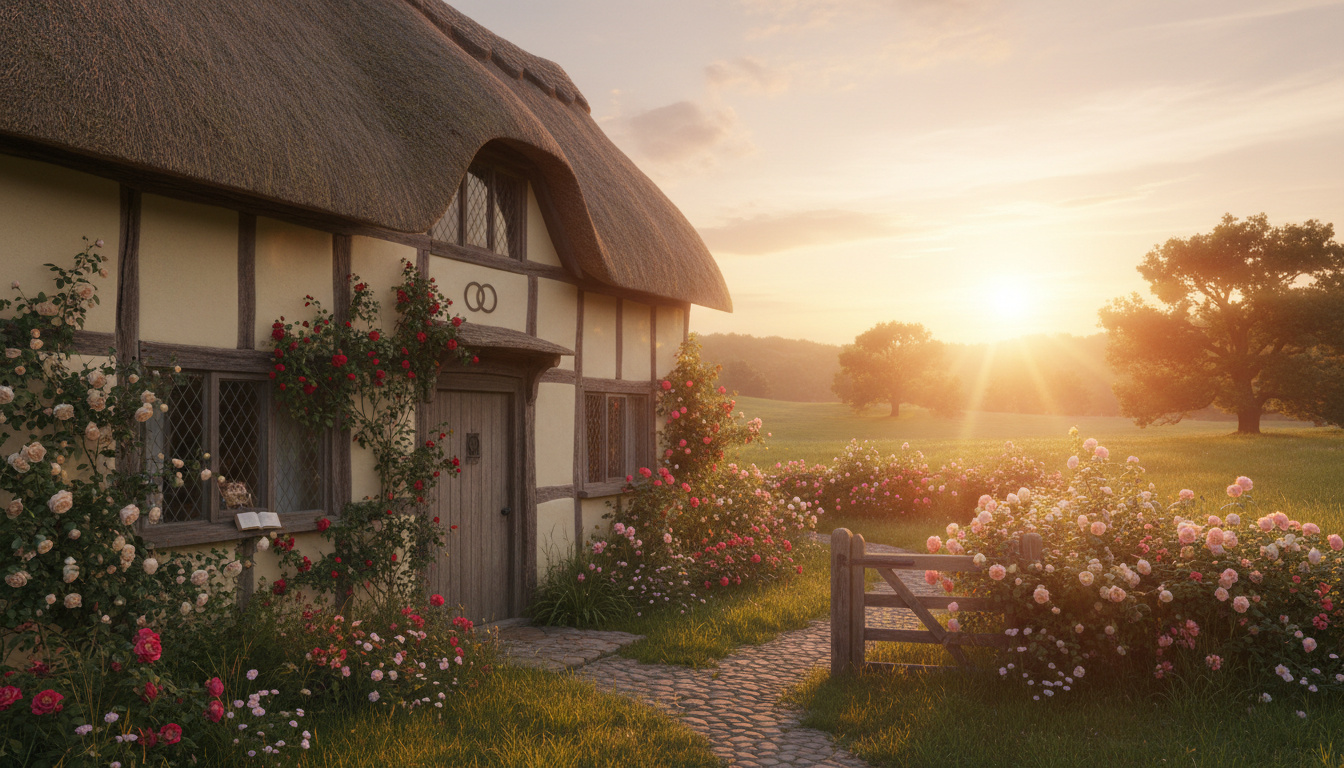
Anne Hathaway was the wife of William Shakespeare, born around 1556 in the village of Shottery, just outside Stratford-upon-Avon. She married the 18-year-old playwright in November 1582 when she was 26 and three months pregnant with their first child, beginning a marriage that would last 34 years despite her husband’s long absences in London.
Historical records provide glimpses of a woman who managed extensive business interests while raising three children in her husband’s absence. Unlike her famous spouse, Anne Hathaway left no personal writings, no letters, and no creative works. What survives are parish records, legal documents, and her husband’s final will—fragments that suggest a life of significant responsibility within the William Shakespeare’s family household.
Today she is remembered through Anne Hathaway’s Cottage, the family farmhouse preserved as a museum, and through persistent debates about her relationship with England’s greatest playwright—questions that highlight both the historical facts available and the significant gaps in the Elizabethan record.
Who Was Anne Hathaway, Shakespeare’s Wife?
- Born to Richard Hathaway, a prosperous landowner who rented a 90-acre farm in Shottery
- Known as “Agnes” in her father’s will, though history records her as Anne
- Operated multiple business ventures including moneylending, property management, and trade
- Managed New Place, Stratford’s largest house, for 19 years while Shakespeare worked in London
- Outlived her husband by seven years, dying at approximately age 67
- Buried beside Shakespeare in Holy Trinity Church, Stratford-upon-Avon
- Her childhood home remained in the Hathaway family for 13 generations before becoming a museum
| Fact | Details |
|---|---|
| Full Name | Anne Hathaway (recorded as Agnes Hathaway in her father’s will) |
| Born | c. 1556, Shottery, Warwickshire, England |
| Died | August 6, 1623 (aged approximately 67) |
| Spouse | William Shakespeare (married November 1582) |
| Children | Susanna (1583), Hamnet (1585–1596), Judith (1585–1662) |
| Father | Richard Hathaway (landowner) |
| Primary Residence | New Place, Stratford-upon-Avon (from c.1597) |
| Final Resting Place | Holy Trinity Church, Stratford-upon-Avon |
According to parish and legal records, Anne came from a farming family that occupied a one-storey farmhouse on substantial land less than 1.5 miles from Shakespeare’s childhood home. The property remained in her family for centuries, eventually becoming one of England’s most visited literary heritage sites.
How Old Was Anne Hathaway When She Married Shakespeare?
Anne Hathaway was 26 years old when she married William Shakespeare on or around November 28, 1582. Her husband was 18, creating an eight-year age gap that has fueled centuries of speculation about the nature of their union.
The Eight-Year Age Difference
In Elizabethan England, it was more common for men to be older than their wives. The reversed age dynamic, combined with Anne’s pregnancy at the time of marriage, has led some historians to characterize the wedding as a “shotgun wedding” forced by circumstance. However, demographic records indicate that approximately 30 percent of brides in the 16th century were pregnant at marriage, often following informal “handfasting” ceremonies that preceded formal church weddings.
The Worcester License
Shakespeare obtained a special license from the Worcester Bishop’s Court to expedite the marriage. The bond listed two Shottery farmers as guarantors, suggesting community support for the union despite the unusual circumstances. Biographical records confirm Anne was three months pregnant when the couple wed.
While the pregnancy and age gap might suggest a forced union to modern observers, 16th-century marriage practices were more flexible than Victorian-era sensibilities might imply. The special license itself indicates the couple sought legitimate sanction rather than hiding their situation.
Duration of the Marriage
The couple remained married for 34 years until Shakespeare’s death in 1616. Despite a 1909 theory by Frank Harris claiming Shakespeare intended to marry Anne Whateley but was forced into this marriage, no evidence supports such claims. Shakespeare lived primarily in London for his theatrical career but visited Stratford annually throughout their marriage.
Did Anne Hathaway and Shakespeare Have Children?
Anne and William Shakespeare had three children together: Susanna, born six months after their wedding, and twins Hamnet and Judith, born nearly two years later. The children’s lives would be marked by both privilege and tragedy, shaping the family’s legacy.
Susanna Shakespeare Hall
Susanna was baptized on May 26, 1583. As the eldest child, she inherited the majority of her father’s property, including New Place, around 1596 or 1597. She married Dr. John Hall, a respected physician, establishing the Shakespeare family’s continued prominence in Stratford society. Encyclopedic records note she became the primary heir of the Shakespeare estate.
The Twins: Hamnet and Judith
The twins Hamnet (a boy) and Judith (a girl) were baptized on February 2, 1585. Hamnet, the only son, died at age 11 in 1596, a loss that scholars have connected to the themes of grief in Shakespeare’s later plays. Judith survived to adulthood but caused controversy when she married Thomas Quiney in February 1616. Quiney had impregnated another woman and mishandled their Lent wedding license, resulting in excommunication from the church. Shakespeare disapproved strongly enough to revise his will, ensuring Judith received her £300 inheritance directly rather than through her husband.
Managing the Household
Following the twins’ birth, the family moved to New Place around 1596–1597. Anne managed this substantial property—the largest house in Stratford—for 19 years while her husband worked in London. Shakespeare retired there in 1613 and died three years later, leaving Anne as widow of a wealthy estate.
What Happened to Anne Hathaway After Shakespeare’s Death?
Anne Hathaway died on August 6, 1623, aged approximately 67, and was buried next to her husband in Holy Trinity Church, Stratford-upon-Avon. She outlived Shakespeare by seven years, continuing to manage family affairs until her death.
Shakespeare’s bequest of the “second best bed with the furniture” to Anne has fueled myths of marital disdain for centuries. However, recent scholarly analysis confirms no evidence supports this negative interpretation. The best bed typically went to the heir (Susanna), while the second bed likely held sentimental value as the marriage bed.
The Will and Inheritance
Shakespeare’s 1616 will directed that Anne receive his second best bed, while his daughter Susanna received the best bed and the bulk of the estate. This distribution reflected standard inheritance practices rather than personal insult. Anne likely had rights to one-third of the estate under English common law regardless of the will’s specific bequests.
Judith’s Marriage Scandal
The final months of Shakespeare’s life were complicated by Judith’s marriage to Thomas Quiney. When Quiney’s moral lapses and legal mishandling became apparent, Shakespeare modified his will to protect Judith’s inheritance, bypassing Quiney entirely. This intervention suggests Anne and her husband maintained communication about family matters despite his London residence.
Research into Elizabethan records indicates Anne Hathaway worked as a malt-maker, property owner, rent-collector, mercer, grocer, licensed vintner, and moneylender. These diverse business interests demonstrate she operated as a significant economic agent in Stratford, not merely a passive wife.
What Were the Key Events in Anne Hathaway’s Life?
- — Born in Shottery, Warwickshire, to landowner Richard Hathaway
- — Marriage to William Shakespeare (license from Worcester Bishop’s Court)
- — Baptism of daughter Susanna
- — Baptism of twins Hamnet and Judith
- — Death of son Hamnet at age 11
- — Family moves to New Place, Stratford’s largest house
- — Shakespeare retires to Stratford
- — Death of William Shakespeare
- — Judith marries Thomas Quiney; Shakespeare revises will
- — Death of Anne Hathaway, aged approximately 67
Source: Historical parish records and legal documents
What Is Known vs. What Remains Uncertain About Anne Hathaway?
| Established Facts | Areas of Uncertainty |
|---|---|
| Born approximately 1556 in Shottery | Exact birth date (no baptismal record survives) |
| Married November 1582 at age 26 | Whether the marriage was emotionally satisfying for both parties |
| Three children: Susanna, Hamnet, Judith | Specific cause of Hamnet’s death |
| Managed New Place from c.1597–1616 | Whether she lived in London briefly (recent letter analysis suggests possibility) |
| Died August 6, 1623 | Her personal feelings about Shakespeare’s long absences |
| Received “second best bed” in will | Shakespeare’s precise motivations for the specific bequest |
| Buried at Holy Trinity Church | Her level of literacy and education |
How Does Anne Hathaway’s Cottage Connect to Her Legacy?
Anne Hathaway’s Cottage, the family farmhouse in Shottery, stands as the primary physical monument to her life. The property remained in the Hathaway family for 13 generations after her death, continuing as a working farm until the Shakespeare Birthplace Trust acquired it in 1892. Today it operates as a museum showcasing Tudor rural life and interpreting the domestic environment that shaped Shakespeare’s wife.
The cottage’s preservation links Anne to a prosperous Hathaway lineage that sustained itself through agriculture and land management for centuries. Visitors to the Shakespeare family sites can view the home where Anne spent her childhood, offering rare tangible connection to a woman whose personal thoughts remain lost to history.
Her legacy beyond the cottage rests on her role as manager of the Shakespeare estate and mother to his heirs. While myths persist about an unhappy marriage characterized by separation and suspected loathing, surviving documentation indicates a stable family unit that endured for three decades despite geographic distance.
What Do Primary Sources Reveal About Anne Hathaway?
Richard Hathaway’s Will, 1581:
“Agnes Hathaway” — The only record of her name in her father’s will, distinguishing her from the “Anne” of historical record and suggesting the fluidity of naming conventions in Elizabethan England.
Worcester Episcopal Registry, 1582:
Marriage bond guaranteeing £40 against legal impediments, with witnesses Fulk Sandells and John Richardson of Shottery, establishing the legal framework for the Shakespeare-Hathaway union.
Shakespeare’s Will, 1616:
“Item I give unto my wife my second best bed with the furniture” — The controversial bequest that has generated more scholarly debate than any other single line regarding Anne Hathaway’s life.
How Is Anne Hathaway Remembered Today?
Anne Hathaway is remembered as a significant figure in England’s literary heritage, not merely as a poet’s wife but as a capable estate manager and businesswoman who maintained the Shakespeare family’s position in Stratford society. William Shakespeare’s family history remains incomplete without acknowledging her 34-year marriage to the playwright, her management of New Place during his London years, and her survival as widow to the world’s most famous dramatist. While no personal letters reveal her private thoughts, the factual record suggests a resilient woman who navigated Elizabethan society with considerable independence.
Frequently Asked Questions
Did Anne Hathaway have any grandchildren?
Yes. Susanna Shakespeare and John Hall had a daughter named Elizabeth, making Anne a grandmother. Judith’s marriage to Thomas Quiney also produced children, though specific details of grandchildren through Judith are less documented in surviving records.
What documents mention Anne Hathaway by name?
Historical records include her father’s will naming her “Agnes Hathaway,” parish registers recording her children’s baptisms, the Bishop of Worcester’s marriage license from 1582, and William Shakespeare’s will bequeathing her the “second best bed.”
What evidence suggests Anne Hathaway worked in trade?
Research indicates she likely operated as a malt-maker, property owner, rent-collector, mercer, grocer, licensed vintner, and moneylender, managing complex financial affairs independently while maintaining the Stratford household.
Did Anne Hathaway ever live in London?
Recent analysis of a letter suggests she may have briefly resided in London with her husband, though she primarily maintained the household in Stratford-upon-Avon throughout their marriage.
What happened to Anne Hathaway’s cottage after her death?
Descendants held the Shottery property for 13 generations until the Shakespeare Birthplace Trust acquired it in 1892, preserving it as a museum of Tudor rural life.
How did the age difference compare to Elizabethan norms?
While the eight-year gap with Anne older was somewhat unusual, approximately 30 percent of brides in the 16th century were pregnant at marriage, suggesting their situation was not entirely outside contemporary social norms.
What was the significance of the name “Agnes” in her records?
Her father’s will referred to her as Agnes Hathaway, though history knows her as Anne. This variation reflects common naming practices of the period, where individuals often appeared under different versions of their names in legal documents.