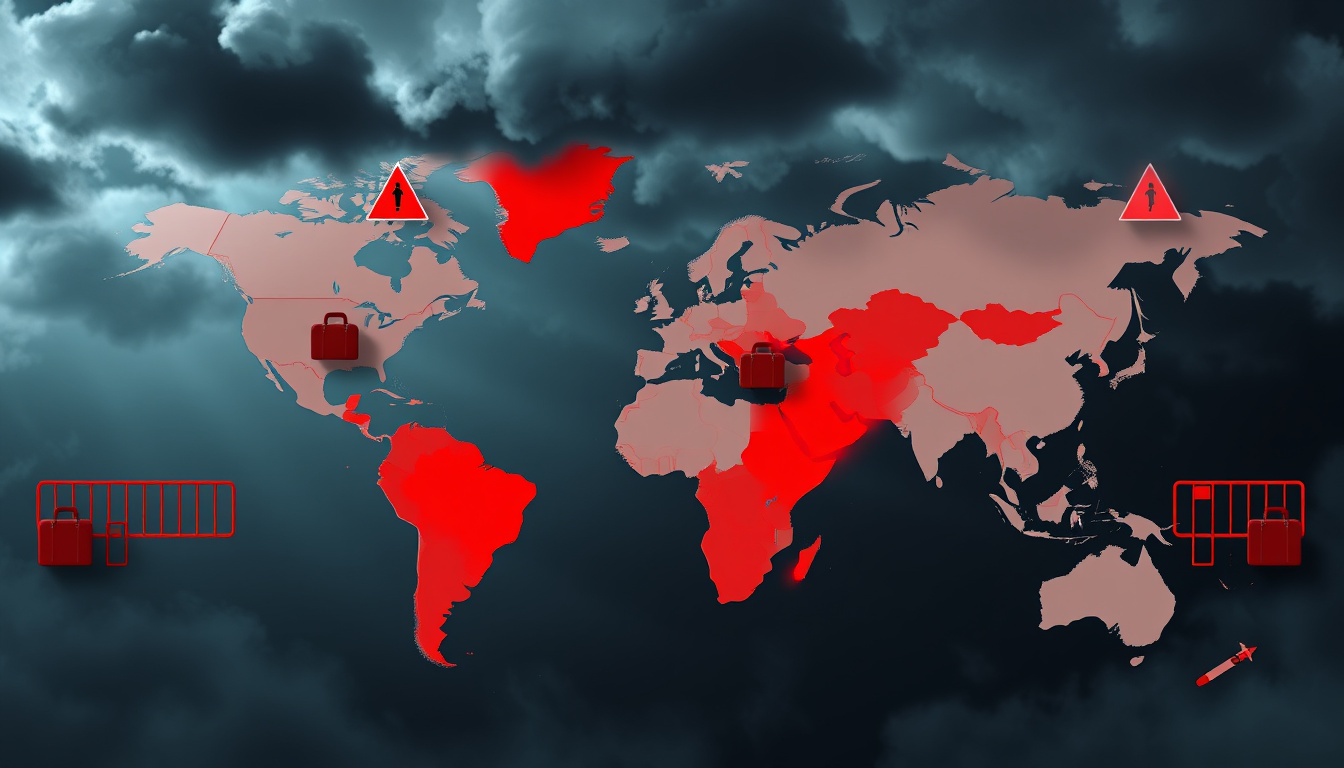
Travel warnings from Ireland, the United States, and the United Kingdom now overlap on more than a dozen high-risk destinations—including Iran, Iraq, Afghanistan, Syria, and Yemen—following escalations tied to US-Israeli strikes on Iran in February 2026. This guide identifies exactly which countries each government advises its citizens to avoid, and what that means for your safety and insurance coverage.
Ireland Do Not Travel List: 24 countries · UK FCDO Against All Travel: 21 countries · US Travel Advisory Levels: 1–4 with Level 4 meaning Do Not Travel
Quick snapshot
- Exact overlap between all three governments’ lists
- Whether advisory changes will extend beyond the Middle East
- Specific triggers for real-time updates to US Level 4 list
- Whether Gulf States will escalate to highest level
- UK FCDO updated on March 1–2, 2026 following US-Israeli strikes on Iran
- US Level 4 snapshot as of April 30, 2026
- Ireland DFA warnings issued amid Middle East tensions
- Governments may further adjust Gulf State ratings
- Travel insurance implications for warned destinations remain uncertain
The table below summarizes key metrics from three major travel advisory systems, allowing quick comparison of scope and risk criteria.
| Label | Value |
|---|---|
| Ireland Do Not Travel Count | 24 |
| US Advisory Levels | 1 (Normal) to 4 (Do Not Travel) |
| UK FCDO List Size | 21 countries |
| Common Risks Cited | Armed conflict, civil unrest, disease |
| US Level 4 Countries | Russia, Ukraine, North Korea, Syria, Iraq, Sudan, South Sudan, DRC, Venezuela, Haiti |
| UK FCDO Updated | March 2, 2026 |
What are the 24 countries on Ireland’s Do Not travel list?
Ireland’s Department of Foreign Affairs maintains four security rating levels for countries worldwide. The highest level—Do Not Travel—currently applies to 24 destinations, driven largely by armed conflict, natural disaster, disease outbreaks, and civil unrest.
The warnings gained renewed attention amid the US-Israeli strikes on Iran in late February 2026, which prompted several governments to reassess their Middle Eastern travel guidance. Ireland DFA upgraded Gulf States including Bahrain, Kuwait, UAE, Saudi Arabia, and Qatar to the second-highest “avoid non-essential travel” level (Her.ie), even though these nations didn’t reach the top tier.
Department of Foreign Affairs security ratings
The Ireland DFA system mirrors international standards with four tiers. Level 1 represents normal precautions, Level 2 indicates increased caution, Level 3 advises reconsideration, and Level 4—the top tier—means absolutely do not travel. These ratings affect consular assistance availability.
Reasons for Do Not Travel warning
According to the Ireland DFA, Level 4 warnings typically stem from armed conflict, natural disasters, disease outbreaks, or civil unrest reaching a point where safe travel is impossible. Travelers who ignore these warnings should note that consular assistance may be limited, and travel insurance coverage could be invalidated (Her.ie).
The implication: if your destination is on Ireland’s Do Not Travel list, you’re essentially traveling without government backstop—and your insurer may refuse claims.
What countries have travel warnings against US?
The US State Department operates a four-tier advisory system: Level 1 (Exercise Normal Precautions), Level 2 (Exercise Increased Caution), Level 3 (Reconsider Travel), and Level 4 (Do Not Travel). As of April 30, 2026, the department has issued Level 4 advisories for 21 countries (CBS News).
US State Department Travel Advisories Levels 1–4
Each advisory level comes with specific guidance. Level 4—the highest—means the department strongly advises US citizens not to travel to these destinations for any reason. Those already present should leave if it is safe to do so (Moneycontrol). The advisories are triggered by factors including crime, terrorism, civil unrest, wrongful detention, health risks, and natural disasters.
Level 4 Do Not Travel destinations
The current Level 4 list includes Russia, Ukraine, North Korea, Syria, Iraq, Sudan, South Sudan, the Democratic Republic of Congo, Venezuela, and Haiti, among others (CBS News). The US government takes such a stern view of these destinations that officials advise Americans planning Level 4 travel to write a will and leave DNA samples with family members—a grim acknowledgment of the risks involved.
What this means: US travelers face significant jeopardy in Level 4 countries, with limited embassy support and potential difficulties leaving. The message from the State Department is unambiguous.
What countries are not recommended for travel right now?
Beyond the US and Ireland, other English-speaking nations maintain their own “do not travel” lists that partially overlap with American guidance. The United Kingdom and Australia both publish advisories with specific implications for their citizens.
UK FCDO against all travel list
The UK Foreign, Commonwealth and Development Office (FCDO) updated its travel warnings on March 1–2, 2026, following the US-Israeli strikes on Iran. As of that update, the FCDO advises against all travel to 21 countries across the Middle East, North Africa, and Central Asia (LADbible). The affected nations include Iran, Iraq, Israel, Lebanon, Syria, Yemen, Afghanistan, Pakistan, Egypt, and several Gulf States.
Australia Smartraveller Do Not Travel
Australia’s Smartraveller program lists countries at the highest risk level, including Iraq and Russia among others. Like the US and UK systems, the Australian advisory strongly discourages travel to these destinations and provides specific guidance for citizens already in affected regions.
The catch: while these lists overlap substantially, they aren’t identical. A country that triggers UK’s highest warning might only warrant Australia’s second-highest caution level, leaving travelers confused about their actual risk.
What countries can Irish people not go to?
For Irish citizens, the DFA’s highest-level warnings define where official support becomes extremely limited. The 24 countries on this list represent the clearest examples of destinations where travel is actively discouraged by Dublin.
DFA Know Before You Go ratings
Ireland’s “Know Before You Go” campaign pairs with the DFA’s security ratings to inform travelers. The program emphasizes that citizens should check country-specific advice before departure and register with the embassy when traveling to higher-risk areas. The current list of 24 Do Not Travel countries was issued amid Middle East tensions and represents the strongest travel warning Ireland can issue (Her.ie).
High-risk overlaps with other nations
Ireland’s list overlaps significantly with UK and Canadian warnings. Notably, certain Caribbean nations appear on multiple high-risk lists, reflecting concerns about crime and civil unrest. The consistency across Western governments suggests shared intelligence about specific threats rather than arbitrary political decisions.
The implication: if you’re an Irish citizen, ignoring a DFA Do Not Travel warning doesn’t just limit consular help—it may void your insurance and leave you entirely on your own in a crisis zone.
Which countries are on high alert?
Beyond strict “do not travel” lists, several systems track countries experiencing elevated security concerns that fall short of the highest warning level. These intermediate warnings deserve attention because they signal deteriorating conditions that could escalate.
Northeastern University High-Risk List
Some institutions maintain their own travel risk assessments. Northeastern University, for example, publishes a Global Safety list that flags countries with significant safety and security concerns. These institutional lists often draw from the same government advisories but may apply different thresholds based on their specific risk tolerance and traveler demographics.
Level 3 Reconsider Travel countries
In the US system, Level 3 Reconsider Travel advisories cover countries where conditions pose serious but not extreme risks. These destinations warrant careful evaluation before travel and may be trending toward Level 4 status. Understanding the difference between Level 3 and Level 4 can help travelers make informed decisions before conditions deteriorate further.
What to watch: several countries currently at Level 3—including some Gulf States recently upgraded by Ireland—could move to higher levels if regional tensions continue. Travelers with upcoming trips should monitor these advisories closely.
Three major English-speaking governments now warn against travel to 21–24 countries. Ireland has the longest list at 24 destinations, while the US and UK both sit at 21. The overlap is substantial: Iran, Iraq, Afghanistan, Syria, and Yemen appear on all three lists.
Travel insurance validity hinges on these advisories. Irish citizens heading to a DFA Level 4 country risk having their claims denied—and US citizens face embassy limitations that make consular crisis assistance nearly impossible.
Confirmed facts
- Ireland DFA lists 24 countries at Do Not Travel level
- UK FCDO updated to 21 countries on March 2, 2026
- US State Department has 21 Level 4 destinations as of April 30, 2026
- All three systems cite armed conflict, civil unrest, and disease as primary triggers
- US Level 4 includes Russia, Ukraine, North Korea, Syria, Iraq, Sudan, South Sudan, DRC, Venezuela, Haiti
- Ireland upgraded Gulf States to second-highest level amid Middle East tensions
What’s unclear
- Exact overlap count between all three advisories
- Whether Gulf States will escalate to highest level
- Post-April 2026 updates to US Level 4 list
- Real-time changes triggered by ongoing regional tensions
“If you are a British national already in Iran, either resident or visitor, carefully consider your presence there and the risks you take by staying.”
— UK FCDO, Government Agency (Evrim Ağacı)
“The department advises Americans to write a will and leave DNA samples if they decide to travel to a Level 4 nation.”
— US State Department, Government Agency (CBS News)
“You should not travel to Afghanistan. The security situation is volatile.”
— UK FCDO, Government Agency (Evrim Ağacı)
“Travelling to these countries may invalidate your travel insurance.”
— Ireland DFA, Government Agency (Her.ie)
For Irish and other Western travelers, the practical consequence of these overlapping advisories is clear: if your destination appears on any of these “do not travel” lists, you face a combination of limited consular help, potential insurance invalidation, and genuine safety risks that governments are now explicitly warning against. The era of treating high-level advisories as mere suggestions is over.
Related reading: Winter Storm Warnings
The UK FCDO echoes these concerns in its Turkey travel warning for British tourists, highlighting risks from terrorism and regional tensions in key areas.
Frequently asked questions
What does Do Not Travel mean?
A Do Not Travel advisory is the highest warning level issued by a government for a specific destination. It means authorities believe conditions in that country pose such serious risks—armed conflict, terrorism, civil unrest, health emergencies, or arbitrary detention—that citizens should not visit under any circumstances. Those already present are advised to leave if safe.
How often do travel advisories update?
Governments update advisories continuously based on changing conditions. Major updates often follow significant events—recent examples include UK FCDO’s sweeping March 2026 changes following US-Israeli strikes on Iran. Travelers should check the latest guidance close to departure and monitor for updates while abroad.
What risks lead to Level 4 warnings?
Level 4 warnings typically result from one or more factors: armed conflict, terrorism threats, civil unrest, wrongful detention risks, disease outbreaks, natural disasters, or crime levels that make safe travel impossible. Different governments weight these factors differently, which explains why lists don’t perfectly overlap.
Can consulates help in Do Not Travel countries?
Consular assistance in Level 4 countries is severely limited. While governments cannot abandon citizens entirely, they typically cannot intervene in local legal systems, arrange evacuation (except in extreme emergencies), or provide services normally available elsewhere. US officials’ advice to write a will before Level 4 travel reflects this reality.
What are Level 3 Reconsider Travel countries?
Level 3 advisories mean serious but not extreme risks exist. Travelers should carefully reconsider plans and understand local conditions before proceeding. These destinations may be trending toward Level 4 status, as seen with Gulf States recently upgraded by Ireland’s DFA.
How does Ireland’s list compare to UK’s?
Ireland currently lists 24 countries at Do Not Travel level, while the UK FCDO warns against travel to 21 countries as of March 2026. Both lists overlap significantly for Middle Eastern destinations, though Ireland’s count is higher, suggesting different thresholds or risk assessments.
What is Northeastern University’s high-risk list?
Northeastern University and some other institutions maintain independent travel risk assessments for their students, faculty, and staff. These lists supplement government advisories with institution-specific considerations, including factors like healthcare access and emergency evacuation capabilities.