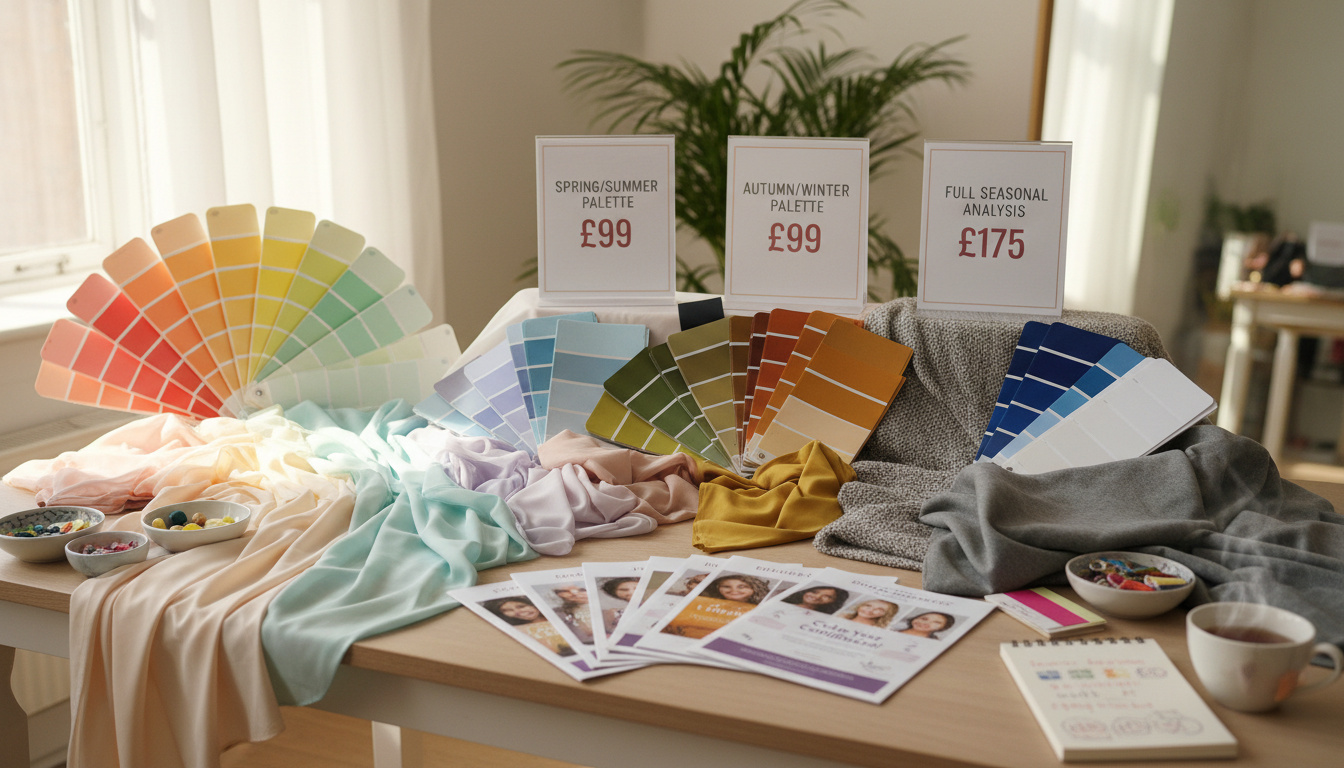
Personal color analysis, commonly called seasonal color analysis, categorizes your features into 12 to 16 distinct color palettes based on undertone, value, and chroma. The process examines how specific hues interact with your skin, hair, and eyes to determine which shades create harmony and which cause distraction under controlled lighting conditions.
Professional services involve draping fabric swatches near the face to observe immediate visual effects on complexion clarity and eye brightness. Consultants assess temperature (warm, cool, or neutral), depth (light to dark), and saturation (bright to muted) to place clients within systems such as Soft Autumn or Bright Spring, often extending recommendations to wardrobe coordination, cosmetic selection, and jewelry metal compatibility.
As interest in personal styling grows, searches for local draping services have increased, with clients seeking tangible validation of their seasonal type through in-person consultation rather than digital assessment tools alone.
What Is Color Analysis?
In-person draping, virtual analysis, or DIY assessment using 12-16 season systems
$250-$399 for professional in-person sessions
60-120 minutes for standard analysis
Wardrobe cohesion and elimination of unflattering purchases
- The 12-season system dominates current practice, though 16-season models offer granular precision for complex coloring
- Undertone determination requires controlled lighting and physical fabric comparison; ambient light alters color perception significantly
- Virtual services rely on photo submissions and questionnaires, costing approximately $295 but potentially sacrificing accuracy due to monitor variations
- Group bookings for events or parties reduce per-person costs while maintaining analytical rigor
- Professional drape kits for home use range from $75 for basic undertone indicators to over $3,397 for complete 119-drape collections
- Metal testing—determining whether gold or silver flatters the client—often reveals unexpected results even within established seasonal categories
- Contemporary practitioners have abandoned rigid 1980s classification methods in favor of fluid, multi-dimensional color theory
| Aspect | Specification | Typical Range |
|---|---|---|
| Undertone Categories | Warm, Cool, Neutral | Temperature assessment |
| Value Measurement | Light to Dark | Contrast level analysis |
| Chroma Intensity | Bright/Vivid to Soft/Muted | Saturation evaluation |
| Standard Session | In-person consultation | 60-120 minutes |
| Individual Pricing | Professional draping service | $250-$399 |
| Remote Alternative | Virtual photo-based analysis | ~$295 |
| Self-Assessment Entry | DIY indicator drapes | $75-$165 per set |
| Season Framework | Analytical categories | 12-16 seasons |
How to Find Color Analysis Services Near Me
Locating certified analysts requires navigating both national directories and regional studios. The House of Colour directory maintains listings of certified stylists across the United States, providing verification of credentials and standardized training backgrounds for in-person sessions.
Regional Service Centers
Specific metropolitan areas host established practices. Los Angeles and Orange County offer multiple options including Mary Komick Style, Hue & Harmony LA in Valencia, and Lily’s Color Lab in Koreatown. The southeastern region includes Refine Image Consulting serving Athens, Georgia, Atlanta, and Knoxville, Tennessee. Drops de Cor maintains certified consultants in various cities, often hosting group events such as birthday parties or corporate sessions at reduced per-person rates.
Search Strategies
Effective queries combine “color analysis” with your specific city or metropolitan area. Examining stylist websites for certification details, draping methodology (12-season versus 16-season systems), and studio lighting specifications helps differentiate professional services from informal offerings.
The House of Colour directory lists certified stylists across the United States, offering verified credentials and standardized methodologies for in-person sessions.
Color Analysis Cost and Session Details
Pricing structures vary by provider geography and service depth. Drops de Cor charges $300 for individual sessions, while Hue & Harmony LA offers in-person analysis at $250. Refine Image Consulting prices services at $350, and Mary Komick Style sessions cost $399. Lily’s Color Lab conducts 80-90 minute sessions with pricing available upon inquiry. Virtual alternatives through Hue & Harmony LA cost $295.
The Draping Process
Sessions commence with neutral lighting setup to eliminate color distortion. Consultants hold custom fabric drapes—organized into 12-season or 16-season sets—near the client’s face, systematically comparing how different temperatures, values, and chromas affect skin clarity, under-eye shadows, and eye brightness. This live comparison reveals whether warm or cool tones, light or dark values, and bright or muted chromas create harmony.
Deliverables and Materials
Standard packages include take-home physical color swatches bound into portable palettes, digital files for mobile reference, and eBook guides covering seasonal coordination. Advanced services incorporate face shape assessment, hair color recommendations, and specific jewelry metal guidance. Lily’s Color Lab and Refine Image Consulting provide comprehensive styling guides alongside basic palette identification.
Remote analysis depends on photo quality and monitor calibration, potentially missing subtle undertone variations visible only under controlled studio lighting with physical fabrics.
Is Professional Color Analysis Worth It?
Client feedback indicates significant confidence enhancement and shopping efficiency. Refine Image Consulting reports transformative results when clients observe colors “make eyes sparkle and skin glow” in real-time. Drops de Cor notes improved wardrobe decision-making following professional typing.
Understanding Seasonal Subtypes
The 12-season system expands classical four-season theory into nuanced categories. Light Spring and Light Summer share pale value but differ in temperature. Deep Autumn and Deep Winter share dark value but diverge in warmth. Bright Spring and Bright Winter share high chroma but contrast in temperature. Soft Summer and Soft Autumn share muted chroma but differ in warmth. Global Color Analysis offers expanded 16-season frameworks for complex neutral undertones.
Cost-Benefit Analysis
At $250-$399 per individual session, the investment requires consideration of wardrobe size and shopping frequency. Group rates reduce individual costs, while DIY kits from Image Consultant Products starting at $75 offer entry-level alternatives. For a comprehensive understanding of the investment involved, you can explore seasonal color analysis services and their associated costs at analisi del colore stagionale.
Modern certified practitioners utilize premium tools and updated color theory, avoiding rigid classification systems prevalent in the 1980s that failed to account for nuanced chroma variations.
What Happens During a Color Analysis Session?
- Pre-session questionnaire regarding current wardrobe composition and styling objectives
- Cleansing of facial area to remove makeup and jewelry for accurate skin assessment
- Calibration of neutral lighting environment, typically using 5000K daylight simulation bulbs
- Systematic draping with test fabrics to isolate undertone temperature without chroma distraction
- Assessment of value contrast and chroma saturation using incremental seasonal comparisons
- Final season placement within 12 or 16 category matrices based on cumulative observations
- Personalized recommendations for clothing coordination, cosmetic selection, hair color, and metal types
- Distribution of physical swatch books, digital palette files, and written reference materials
What Remains Uncertain About Color Analysis?
| Established Facts | Unverified or Unclear Information |
|---|---|
| Physical draping under standardized 5000K lighting provides reliable undertone assessment | Long-term stability of seasonal typing as skin pigmentation changes with age or hormonal shifts |
| Certified training programs require mastery of color theory and seasonal typing matrices | Absolute precision of virtual analysis compared to in-person draping due to digital color rendering variations |
| 12-16 season frameworks represent current industry standards for categorization | Universal applicability of seasonal systems across all ethnic backgrounds and dermatological conditions |
| Metal testing (gold vs silver) consistently reveals objective flattery patterns | Correlation between seasonal typing and psychological preference or cultural color associations |
The Evolution of Color Analysis Methodology
Contemporary personal color analysis descends from early 20th-century color theory but has significantly diverged from its origins. K Griffin Style notes that modern practitioners avoid the restrictive “otype” classifications popular in the 1980s, which forced individuals into four rigid categories without accounting for chroma variations or neutral undertones.
Current systems employ logarithmic progressions through 12 and 16-season matrices, allowing for soft transitions between traditional seasonal boundaries. This evolution enables accurate typing for individuals who previously fell between categories, particularly those with neutral undertones or unusual contrast levels.
While color analysis focuses on aesthetic enhancement through pigment interaction, accurate assessment of physical characteristics extends to other domains such as White Spots on Skin – Causes, Treatments and When to Worry, where visual examination plays a critical diagnostic role.
Expert Perspectives on Color Analysis
Transformation occurs when clients see colors make eyes sparkle and skin glow in real-time, eliminating years of uncertain shopping decisions.
— Refine Image Consulting
Budget-friendly online analysis extends beyond basic draping to incorporate lifestyle and wardrobe integration, though in-person remains the gold standard for accuracy.
— K Griffin Style
Making the Decision on Color Analysis
Selecting between in-person draping, virtual assessment, or DIY methodologies depends on budget constraints, geographical access, and desired precision. Local certified analysts provide the most accurate undertone identification through controlled draping, while virtual and self-assessment options offer entry points for those exploring seasonal theory. For additional guidance on measuring physical spaces and dimensions, refer to How Big Is a Queen Size Bed – Standard Dimensions Guide.
Common Questions About Color Analysis
How should I prepare for a color analysis appointment?
Arrive with a cleansed face free of makeup, tinted moisturizer, or self-tanner. Remove jewelry that might reflect color onto your skin. Wear a neutral top or the provided studio draping cape to prevent clothing color from affecting the assessment.
Can my color season change as I age?
Seasonal typing reflects underlying skin pigmentation and contrast levels, which may shift with age, hormonal changes, or hair graying. Some practitioners recommend reassessment every 5-10 years or after significant physical changes.
What distinguishes 12-season from 16-season analysis?
The 12-season system creates tertiary categories between traditional four-season groups. The 16-season system adds further granularity for complex neutral undertones, providing more precise placement for individuals between standard classifications.
Are group color analysis sessions accurate?
Group sessions maintain analytical accuracy for basic seasonal typing but may offer limited time for individual questions. Draping methodology remains identical to private sessions, though personalized recommendations receive less discussion time.
How does virtual analysis compare to in-person draping?
Virtual services analyze submitted photographs and questionnaires to generate digital palettes. While convenient, this method cannot replicate the subtle temperature and chroma comparisons possible with physical fabric draping under calibrated lighting.
What DIY tools provide the most accurate self-assessment?
Professional-grade undertone drapes starting at $75 offer better accuracy than printed color charts. Complete 119-drape kits provide comprehensive assessment capabilities but require training to interpret results accurately.