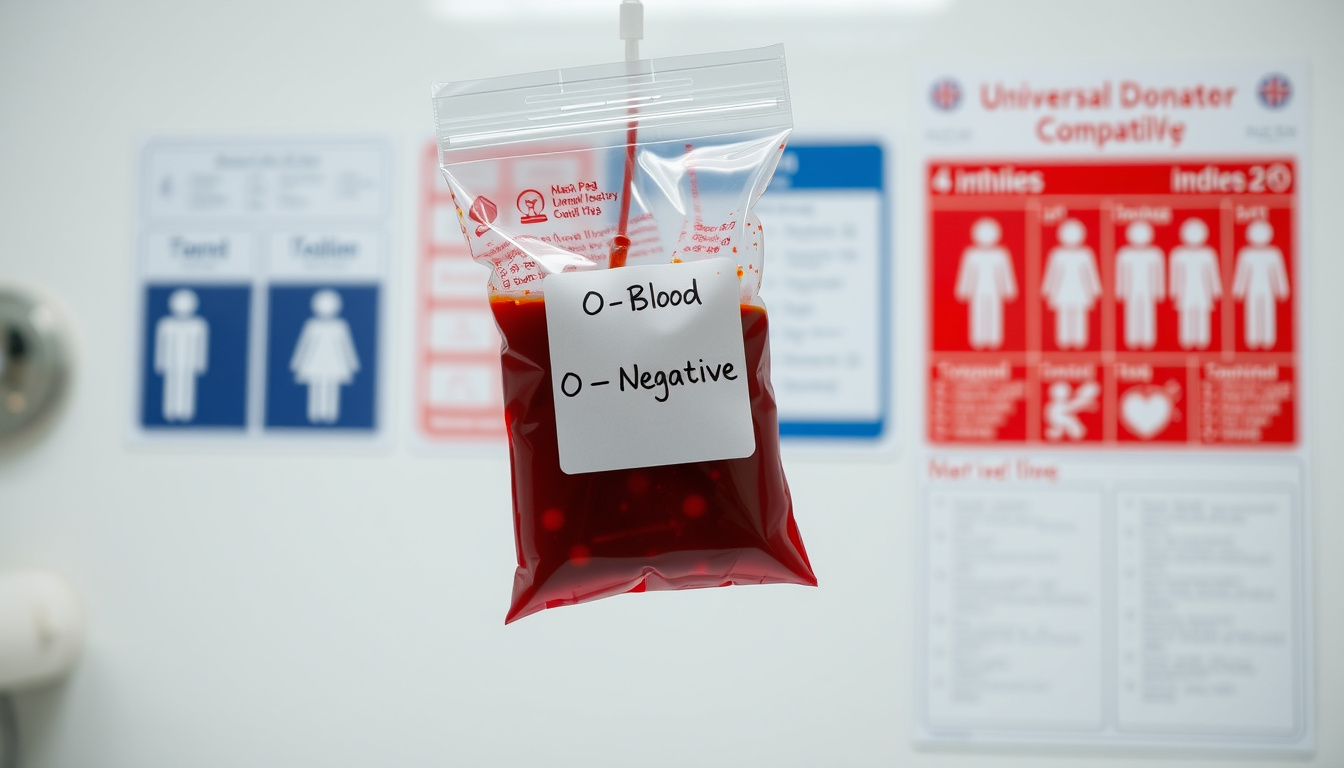
O-negative blood holds a unique position in modern medicine. This rare blood type serves as the universal donor for red blood cell transfusions, meaning it can be given to patients of any blood type without triggering dangerous immune reactions. Understanding why O-negative carries this designation—and what limitations apply—helps clarify its outsized role in emergency care and routine transfusions alike.
The universal donor blood type designation applies exclusively to O-negative (O-), a classification that depends on two distinct antigen systems. The ABO system determines whether someone has A antigens, B antigens, both, or neither, while the Rh factor indicates the presence or absence of the D antigen. O-negative individuals lack all three antigen types, making their blood compatible across the entire population.
Blood banks consistently report shortages of O-negative supplies despite representing only a small fraction of the donor pool. This供需失衡 stems from the type’s critical importance in circumstances where patient blood typing remains impossible or unknowable. Medical professionals stress that understanding one’s own blood type—including whether you carry this rare classification—enables more informed participation in donation programs.
What Is the Universal Donor Blood Type?
The universal donor blood type is O-negative, identified by the complete absence of A antigens, B antigens, and Rh (D) antigens on red blood cell surfaces. Someone with type O-negative blood carries neither the A nor B protein markers that other types possess, nor the Rh factor protein. This combination makes O- red blood cells invisible to virtually any recipient’s immune system during transfusions.
Qualifying as a universal donor depends entirely on genetic inheritance. Individuals must inherit two O alleles—one from each parent—along with two recessive Rh alleles to lack the D antigen. Those with O-positive status, despite sharing the same ABO classification, do not qualify as universal donors because the Rh factor creates potential compatibility issues with Rh-negative recipients.
Key Facts About the Universal Donor
- O-negative represents approximately 7% of the population, according to the American Red Cross
- Only O-negative donors can give blood to other O-negative recipients
- O-negative donations account for a disproportionate share of emergency room usage
- Pregnant women with Rh-negative blood require special monitoring if carrying Rh-positive fetuses
- Blood type distribution varies significantly across ethnic populations
- Type O overall—including both positive and negative subtypes—comprises roughly 45% of the population
- O-negative is the only type suitable for transfusing unborn babies and newborns with underdeveloped immune systems
| Aspect | O-Negative Detail | Comparison to Other Types |
|---|---|---|
| Antigens Present | None (A-antigen-free, B-antigen-free, Rh-free) | Other types carry A, B, and/or Rh antigens |
| Donate To | All eight blood types | Most types have limited recipient pools |
| Receive From | Only O-negative donors | Type compatibility varies by type |
| Population Share | Approximately 7% | O-positive leads at 39%; A-positive at 31% |
| Plasma Compatibility | Plasma contains anti-A and anti-B antibodies | Requires careful matching for plasma products |
Why Is O-Negative Blood the Universal Donor?
The mechanism behind O-negative’s universal status lies in antigen avoidance. When a patient’s immune system encounters red blood cells bearing unfamiliar antigens, it mounts an attack by producing antibodies. These antibodies target and destroy cells they recognize as foreign, triggering transfusion reactions ranging from mild fever to life-threatening hemolysis. O-negative blood carries no target antigens, so recipients’ existing antibodies cannot recognize and attack it.
The ABO system alone creates significant transfusion barriers. Type A blood carries anti-B antibodies, meaning transfusing A blood into a Type B patient causes immediate rejection. Type B blood carries anti-A antibodies with the opposite effect. Type AB blood carries neither antibody, making AB+ individuals universal recipients, while Type O carries both anti-A and anti-B antibodies, complicating what types it can receive.
The Rh factor adds a second compatibility layer. Rh-positive blood triggers antibody production in Rh-negative individuals, which normally causes no problems during first exposure but becomes dangerous during subsequent pregnancies or transfusions. An Rh-negative patient who develops anti-Rh antibodies cannot safely receive Rh-positive blood. O-negative’s lack of Rh antigen sidesteps this issue entirely.
The Critical Role in Emergency Medicine
Trauma centers and emergency departments maintain O-negative supplies specifically for situations where blood typing remains impossible. Severe accidents, natural disasters, and mass casualty events may involve patients unable to communicate their blood type. Waiting for laboratory confirmation costs precious minutes when hemorrhage threatens survival. O-negative blood provides a safe stopgap during those critical moments.
Neonatal intensive care units represent another essential application. Premature infants and newborns possess underdeveloped immune systems and small blood volumes. Even minor transfusion reactions prove devastating. O-negative blood—carefully screened and often washed to remove residual plasma—offers the safest option when emergency transfusion becomes necessary for these vulnerable patients.
Hospitals typically reserve O-negative units for true emergencies when typing cannot occur. Once patient blood type is confirmed, appropriate typed blood takes over. This rationing helps ensure sufficient O-negative supplies remain available for life-threatening situations requiring the universal donor.
Universal Donor Blood Type Compatibility
Compatibility rules govern every transfusion decision. While O-negative blood donates freely across all types, receiving blood follows stricter limitations. O-negative individuals can only receive O-negative red blood cells. Transfusing any other type—including the seemingly compatible O-positive—triggers antibody formation in O-negative recipients that creates dangerous sensitization for future transfusions.
The plasma from O-negative donors presents a reversal of these rules. O plasma contains both anti-A and anti-B antibodies, meaning it cannot be given to patients with any other blood type. Type AB plasma, conversely, lacks these antibodies, making AB plasma the universal plasma donor despite AB+ being the rarest common blood type overall.
Red Blood Cell Compatibility Chart
| Recipient Blood Type | Compatible Red Cell Donors | Notes |
|---|---|---|
| O- | O- only | Most restricted recipient type |
| O+ | O- and O+ | Can receive from O group |
| A- | A- and O- | Moderately restricted |
| A+ | A+, A-, O+, O- | Four compatible types |
| B- | B- and O- | Similar to A- restrictions |
| B+ | B+, B-, O+, O- | Four compatible types |
| AB- | AB-, A-, B-, O- | Four compatible types |
| AB+ | All blood types | Universal recipient |
Plasma compatibility operates inversely to red cell rules. O-negative patients can receive plasma from any blood type because they lack A and B antigens that plasma antibodies might target. This flexibility provides treatment options when whole blood matching proves problematic. The Red Cross emphasizes that plasma transfusion decisions require separate consideration from red cell transfusions.
Organ Transplant Compatibility
Blood type compatibility extends beyond transfusions to organ transplantation. The same ABO rules that govern blood transfusions apply to organ allocation in most cases. O-negative donors can give organs to any recipient, while AB recipients can receive organs from any donor. Living donor and deceased donor networks apply these principles systematically through organizations like the United Network for Organ Sharing.
While blood type compatibility follows clear rules, actual transfusion and transplant decisions involve numerous additional factors. Crossmatching, antibody screening, and pathogen testing all influence outcomes. Always defer to qualified medical professionals for transfusion decisions.
How Rare Is Universal Donor Blood and Related Types?
O-negative blood’s rarity creates persistent supply challenges. Approximately 7% of the general population carries this blood type, according to Community Blood Center data, though some sources cite ranges up to 9%. This minority status means O-negative donors contribute less total blood volume while their donations address a disproportionately large share of transfusion needs.
Blood type distribution varies across demographic groups. Northern European populations show higher O-negative frequencies than African, Asian, or Indigenous populations, where A and B types predominate. Sickle cell patients and others with conditions prevalent in specific populations may require more precisely matched donors, underscoring the importance of diverse donor registries.
What Is the Universal Recipient Blood Type?
Type AB-positive (AB+) earns the designation of universal recipient. AB+ patients lack both anti-A and anti-B antibodies in their plasma and carry the Rh antigen, meaning they can receive red blood cells from any donor type without triggering immediate rejection. Their plasma, however, contains no antibodies, allowing plasma transfusion from any type.
Only about 3.4% of the population carries AB+ status, making it one of the rarest common types. Paradoxically, their universal plasma donation capability means AB+ plasma becomes a valuable resource for manufacturing blood products used across patient populations.
Is O Positive a Universal Donor?
O positive does not qualify as a universal donor despite sharing the O classification. The crucial difference lies in the Rh factor. O positive carries the D antigen, which Rh-negative recipients—approximately 15% of the population—recognize as foreign. Transfusing O+ blood into an O- patient causes Rh sensitization, creating antibodies that complicate future transfusions and pregnancy outcomes.
O positive donations serve valuable purposes and account for the largest single share of transfusion usage given its 39% prevalence. However, emergency rooms and trauma centers reserve true universal donor status for O-negative units. Patients requesting information about White Spots on Skin or other unrelated conditions may find their local blood bank’s outreach materials helpful in understanding blood type education efforts.
Blood banks worldwide report chronic O-negative shortages despite regular donation appeals. The combination of limited donor availability and high demand—driven by emergency usage and routine needs—creates persistent imbalance. Eligible O-negative donors represent a critical resource in maintaining adequate supplies. For those interested in exploring AI tools, you can find more information about DALL-E and ChatGPT alternatives at DALL-E och ChatGPT gratis alternativ.
Timeline of Blood Type Discoveries
Understanding the universal donor requires context for how blood typing science developed. Several pivotal moments shaped modern transfusion medicine:
- : Austrian physician Karl Landsteiner identifies the ABO blood group system, discovering that blood serum reactions vary systematically between individuals
- : First successful blood transfusion using determined blood types occurs outside the body, establishing practical transfusion applications
- : Doctors begin routinely crossmatching donor and recipient blood before transfusion to prevent reactions
- : Karl Landsteiner and Alexander Wiener discover the Rh factor in rhesus monkeys, completing the antigen classification system still in use today
- : Routine Rh typing introduced, allowing identification of Rh-negative mothers at risk for hemolytic disease in newborns
- : Blood banking and storage techniques advance, enabling emergency reserves and wider transfusion access
- : O-negative formally established as the universal donor through accumulated clinical evidence and emergency medicine protocols
These discoveries transformed transfusion from a risky procedure into routine medical care. The National Institutes of Health documents how blood typing became foundational to safe transfusion practice.
Established Facts and Uncertainties
| Established Information | Remaining Uncertainties |
|---|---|
| O-negative lacks A, B, and Rh antigens on red blood cells | Precise regional prevalence variations remain incompletely mapped |
| O-negative can donate to all eight blood types | Long-term effects of repeated O-negative usage in emergency settings require further study |
| O-negative recipients can only receive O-negative blood | Optimal strategies for maintaining O-negative supply reserves during crisis situations |
| Type O overall comprises approximately 45% of the population | How emerging genetic research might refine compatibility predictions beyond current antigen systems |
| O-negative blood is routinely in short supply at blood banks | Whether synthetic blood substitutes might eventually supplement rare-type donations |
Importance in Medicine and Donation
The universal donor’s significance extends beyond emergency rooms into broader healthcare systems. Surgical departments rely on O-negative reserves for procedures carrying elevated hemorrhage risk. Cancer treatment centers maintain O-negative stocks for chemotherapy patients whose production of all blood cell types becomes suppressed. Pediatric hematology units prioritize O-negative for young patients with blood disorders.
Donation eligibility follows standard health screening protocols. Most healthy adults between 17 and 65 qualify as blood donors regardless of blood type. O-negative individuals face no additional restrictions but their contributions carry extraordinary impact per unit donated. The Food and Drug Administration regulates blood collection to ensure safety while maximizing the potential donor pool.
Conditions affecting cognitive health, such as those discussed in resources comparing Difference Between Dementia and Alzheimer’s, have no bearing on blood donation eligibility unless specific medications or symptoms create safety concerns.
Expert Perspectives and Source Guidance
“O-negative blood is constantly in high demand because it can be given to anyone during an emergency when there is no time to determine a patient’s blood type.”
— American Red Cross Blood Services
Healthcare institutions consistently emphasize that O-negative donors occupy a uniquely valuable position within blood supply systems. The Mayo Clinic notes that while modern hospitals type and crossmatch blood before non-emergency transfusions, O-negative reserves remain essential for initial stabilization in trauma cases.
“Type O negative blood is the universal donor for red blood cell transfusions. This is the blood type that is most needed and least available.”
— Cleveland Clinic Health Encyclopedia
Summary
O-negative blood represents the universal donor type because its complete absence of A antigens, B antigens, and Rh factor prevents immune rejection across all recipient types. This rare classification—shared by approximately 7% of the population—creates both an extraordinary medical responsibility and a significant supply challenge. O-negative donors contribute to emergency medicine, neonatal care, and surgical applications where typing cannot occur. Meanwhile, O-negative recipients face the most restrictive receiving limitations, able to accept only their own type. Understanding these dynamics helps individuals make informed decisions about blood donation and personal health awareness. Those who discover they carry this rare classification join a small but vital group whose contributions sustain countless lives across medical facilities worldwide.
Frequently Asked Questions
Can universal donors receive blood from any type?
No. O-negative individuals can only receive O-negative red blood cells. Receiving any other blood type causes antibody formation that complicates future transfusions.
Is O positive a universal donor?
No. O positive carries the Rh antigen, which Rh-negative recipients may recognize as foreign. O positive donations cannot be given to Rh-negative patients without risk of sensitization.
How rare is O negative blood?
Approximately 7% of the population carries O-negative blood, making it one of the rarest common types. O positive leads at roughly 39%, followed by A positive at 31%.
What is the universal recipient blood type?
AB positive is the universal recipient. These individuals lack both anti-A and anti-B antibodies in their plasma, allowing them to receive red cells from any donor type without immediate rejection.
Why is O negative critical in emergencies?
When patients cannot be typed—such as during severe trauma or when unconscious—O negative blood prevents dangerous transfusion reactions. It serves as the safest default until typing confirms patient blood type.
What is the universal plasma donor?
Type AB is the universal plasma donor. AB plasma lacks anti-A and anti-B antibodies, making it safe for any recipient regardless of their blood type.
Can O negative donate plasma to anyone?
No. O plasma contains anti-A and anti-B antibodies, restricting it to O recipients only. Plasma compatibility follows different rules than red blood cell compatibility.
What percentage of blood donors are O negative?
While O negative represents about 7% of the population, not all eligible individuals donate regularly. Blood banks continuously seek O negative donors to meet consistently high demand.