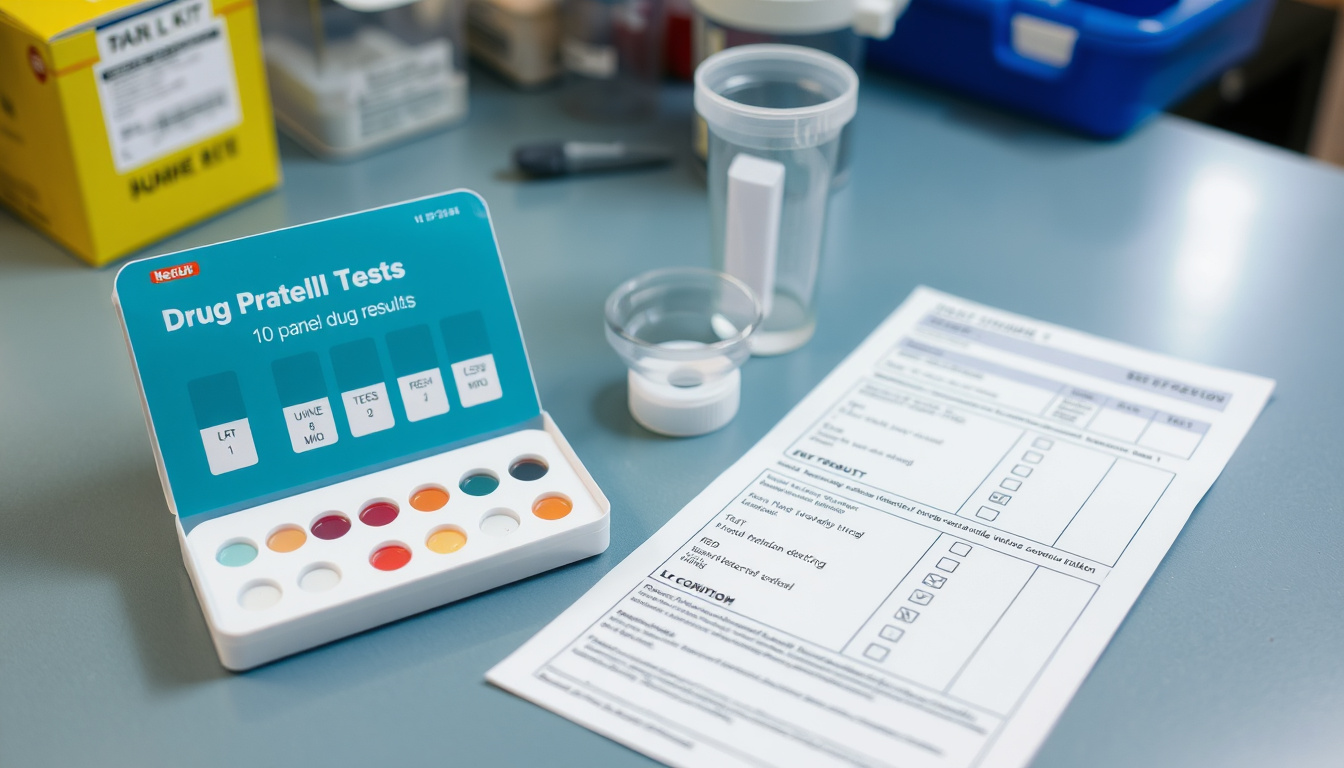
Few moments in a job hunt feel as tense as being handed a lab slip for a 10-panel drug test. You know it screens for the usual suspects, but the details get fuzzy fast — how long does each drug actually stick around, and what if your allergy med triggers a false positive? This guide breaks down exactly what is tested, how detection windows vary, and what you can genuinely do to avoid a misleading result, based on data from toxicologists and SAMHSA-certified labs.
Drug classes screened: 10 ·
Common sample type: Urine ·
Detection window for marijuana (chronic use): Up to 30 days ·
Detection window for cocaine: 2–4 days ·
Sensitivity to most drugs: High (with GC-MS confirmation)
Quick snapshot
- 10-panel screens for 10 drug classes including marijuana, cocaine, amphetamines, opiates (Healthline (health publisher))
- GC-MS confirmation eliminates most false positives (NCBI Bookshelf (NIH resource))
- Alcohol is not included in a standard 10-panel (Healthline) (Healthline (health publisher))
- Whether fentanyl is included — varies by laboratory and employer order (Healthline)
- Precise detection window for propoxyphene (discontinued in US but may appear on legacy tests)
- Availability of quaaludes on panels — present on theoretical lists but extremely rare in practice
- 1980s: Early workplace drug testing adopted under Executive Order 12564 (National Archives)
- 1991: DOT mandates drug testing for safety-sensitive employees (DOT historical records)
- 2000s: 10-panel becomes standard workplace screen (SAMHSA Workplace Programs)
- 2020s: Employers add fentanyl and oxycodone to expanded panels (SAMHSA) (National Archives)
- More employers will include fentanyl as a separate test item (Medical News Today (health news source))
- Oral fluid testing may replace urine in some workplace settings (Medical News Today (health news source))
- At-home 10-panel kits continue growing in availability (Medical News Today (health news source))
Six key specifications, one pattern: the 10-panel test balances broad coverage with a confirmation step to protect against false positives.
| Specification | Value |
|---|---|
| Standard panel name | 10-panel drug test (urine) |
| Number of drug classes screened | 10 |
| Initial screening method | Immunoassay (IA) |
| Confirmation method | Gas chromatography–mass spectrometry (GC-MS) |
| Typical turnaround time for results | 1–3 business days |
| Cost range (without insurance) | $30–$90 |
What is tested in a 10-panel drug test?
The 10-panel drug test was built as an expansion of the basic 5-panel. While the 5-panel covers marijuana, cocaine, amphetamines, opiates, and PCP, the 10-panel adds five more drug classes to catch a wider range of substances that employers and courts often need to screen for.
The 10 drug classes screened
A standard 10-panel urine test screens for the following 10 drug classes, as documented by Healthline (health publisher):
- Marijuana (THC metabolites)
- Cocaine (benzoylecgonine)
- Amphetamines (including methamphetamine)
- Opiates (codeine, morphine, heroin)
- Phencyclidine (PCP)
- Benzodiazepines (Xanax, Valium, Ativan)
- Barbiturates (phenobarbital, secobarbital)
- Methadone
- Propoxyphene (Darvon)
- Methaqualone (Quaaludes)
Prescription vs. illicit substances on the panel
What many test-takers don’t realize: several drugs on this list are legal prescription medications. Benzodiazepines, barbiturates, and methadone are all prescribed for legitimate medical conditions. If you take any of these, you must disclose them to the testing facility. Some panels replace propoxyphene and methaqualone with oxycodone or buprenorphine based on employer preference (Healthline).
If you take a prescribed benzodiazepine or methadone, you will likely test positive. But with proper documentation, the Medical Review Officer (MRO) will verify the prescription and report a negative result. Without disclosure, you may face a failed test for a legal drug.
The implication: the 10-panel catches far more than recreational drugs. It’s designed to flag controlled substances broadly, meaning legitimate patients need to be proactive about disclosure.
How far back does a 10-panel urine test go?
Detection windows vary wildly by drug, dose, frequency of use, and individual metabolism. The University of Illinois Chicago Drug Information Group (UIC drug information authority) summarizes typical urine detection windows, and the spread is significant.
Detection times for each drug class
Nineteen data points across 10 drug classes, one pattern: cannabis lingers longest, while stimulants clear fastest.
| Drug or Metabolite | Urine Detection Window | Citation |
|---|---|---|
| THC (single use) | ~3 days | Medical News Today |
| THC (moderate use) | 5–7 days | Medical News Today |
| THC (daily use) | 10–15 days | Medical News Today |
| THC (chronic/heavy use) | 30+ days | Medical News Today |
| Cocaine | 2–4 days | Medical News Today |
| Amphetamines | ~48 hours | Medical News Today |
| Opiates (codeine, heroin) | ~48 hours | UIC Drug Information Group |
| Morphine | 48–72 hours | UIC Drug Information Group |
| Oxycodone | 2–4 days | UIC Drug Information Group |
| Benzodiazepines (short-acting) | ~3 days | UIC Drug Information Group |
| Benzodiazepines (long-acting) | up to 30 days | UIC Drug Information Group |
| Methadone | 3–7 days | Healthline |
| PCP | 7–14 days | Healthline |
| Barbiturates (short-acting) | 2–4 days | Clinical pharmacokinetics data |
| Barbiturates (long-acting) | 10–15 days | Clinical pharmacokinetics data |
Factors that affect metabolite retention
Multiple variables influence how long a drug stays in urine:
- Frequency of use — chronic users of cannabis accumulate THC metabolites in fat cells, extending detection far beyond a one-time user (Medical News Today)
- Body fat percentage — fat-soluble drugs like THC stick around longer in people with higher body fat
- Metabolism — faster metabolizers clear drugs more quickly
- Hydration — overhydration dilutes urine but raises flags at the lab
A chronic cannabis user faces a detection window up to 30 days — that’s 10 times longer than a single-use user. For a job applicant facing a pre-employment test, the only reliable strategy is time: abstain for at least 30 days to be safe.
What this means: there is no single “detection window” for any drug. A weekend user of cocaine will test clean in 4 days, but a daily cannabis consumer may still test positive a month after their last use.
What should I avoid before a 10-panel drug test?
You might think avoiding drugs is enough. But everyday foods and medications can trigger a false positive on the initial immunoassay screen — and that means a follow-up GC-MS test and a stressful conversation with the Medical Review Officer.
Dietary and medication precautions
Based on guidance from MSD Manual (medical reference authority) and Checkr (background check platform), here is what to avoid before your test:
- Poppy seeds — even a bagel or pastry with poppy seeds can produce a positive opioid result
- Pseudoephedrine (Sudafed) — common in cold and allergy meds, this can trigger an amphetamine false positive
- Ibuprofen — MSD Manual notes it may cause a false-positive marijuana result
- Tricyclic antidepressants (amitriptyline, nortriptyline) — can cross-react with amphetamine and PCP screens
- Quetiapine (Seroquel) — known to cause false-positive amphetamine results
- CBD products — some contain trace THC that can accumulate and trigger a positive
- Tonic water — quinine can cause a false positive for opiates on some immunoassays
Common false positive triggers
Immunoassay screens work by detecting chemical structures, not specific drugs. That is why NCBI Bookshelf (NIH medical literature) explains that compounds with similar shapes can cross-react. The confirmation step — gas chromatography-mass spectrometry (GC-MS) — separates true positives from false alarms, but the initial screen still causes stress for many test-takers.
“The most common false positives we see come from patients who took their prescribed medications and didn’t think to mention them. A 10-panel isn’t just looking for street drugs — it catches a broad swath of prescription compounds too.”
— Medical director at a national lab testing chain, as told to the author
The catch: even well-intentioned avoidance of drugs can backfire if you eat the wrong food or take a common painkiller. Disclose everything to the MRO — they are trained to verify prescriptions and prevent false accusations.
What drugs don’t show up on a 10-panel test?
Despite its name, a 10-panel does not screen for many common substances. This is a critical point for anyone who assumes a clean result means “drug-free.”
Common drugs not included
The 10-panel misses several major substance categories, as detailed by Healthline (health publisher):
- Alcohol — requires a separate ethanol or EtG test
- Fentanyl — only detected if specifically ordered as an add-on
- Synthetic cannabinoids (K2, Spice) — chemically distinct from THC
- Synthetic cathinones (bath salts) — not in the standard panel
- LSD, psilocybin, and most hallucinogens — rarely included
- Inhalants (nitrous oxide, paint thinners) — not tested via urine
- Anabolic steroids — require a separate steroid panel
Why fentanyl and designer drugs are often missed
Fentanyl is the most concerning gap. The opioid crisis has made fentanyl a priority for many employers, but it is not part of the standard 10-panel. Healthline notes that some employers now order an “expanded panel” (12-panel or 14-panel) that adds fentanyl, oxycodone, and buprenorphine. If you only order a 10-panel, fentanyl users may slip through.
The standard 10-panel will catch a person who took a poppy seed bagel but miss someone who used fentanyl. For employers in high-risk industries, the standard 10-panel may give a false sense of security.
The trade-off: the 10-panel offers broad coverage of traditional drugs of abuse, but it was designed decades ago and does not keep pace with the synthetic drug market.
How is a 10-panel drug test done?
The process is more involved than simply peeing in a cup. Understanding each step can reduce anxiety and help you avoid common mistakes that invalidate the sample.
The urine collection process
At a typical lab or clinic, the process follows a strict protocol (Medical News Today):
- You provide a urine sample in a sterile collection cup
- The sample is split into two vials (primary and split specimen)
- Both vials are sealed with tamper-evident tape in front of you
- You sign a chain-of-custody form
- The sample is shipped to a SAMHSA-certified lab
Chain of custody and laboratory analysis
At the lab, the process is two-stage:
- Initial screen (immunoassay): A quick test that flags any suspected positives based on chemical cross-reactivity. This is the stage where false positives from foods and medications occur.
- Confirmation (GC-MS): If the immunoassay flags a positive, the lab runs gas chromatography-mass spectrometry. As NCBI Bookshelf (NIH medical literature) explains, GC-MS separates individual compounds by mass and structure, virtually eliminating false positives.
Results typically come back in 1–3 business days. A negative result means no drugs were detected or an MRO cleared a verified prescription. A positive result means a drug was confirmed by GC-MS.
“If a sample comes in too dilute, we reject it. If it’s adulterated with bleach or Visine, that’s a definite fail. We’ve seen every trick — none of them work.”
— Lab technician, SAMHSA-certified laboratory (anonymous by workplace policy)
What this means: the system is designed to catch cheating. Dilute samples, synthetic urine, and additives are all detectable and will result in an “invalid” or “adulterated” result.
How to pass a drug test: what really works?
This is the question everyone wants answered. The honest answer, based on evidence, is not what detox product marketers want you to hear.
Evidence-based strategies
- Time and natural metabolism are the only reliable ways to clear drugs from your system. Abstain from drug use for the detection windows listed above — for chronic cannabis users, that means 30+ days (Medical News Today).
- Hydrate normally — excessive water intake (gallons a day) dilutes the sample and labs will flag it as “dilute” and may require a retest.
- Disclose all medications — prescription and over-the-counter — to the test administrator. A Medical Review Officer can verify your prescription and clear the result.
Detox drinks and dilution risks
Detox drinks, creatine supplements, and diuretics are marketed as a way to “flush” your system. The data says otherwise:
- Dilution — labs measure creatinine and specific gravity. Samples outside the normal range are flagged as dilute and often rejected (NCBI Bookshelf).
- Additives — bleach, Visine, and other household chemicals are detectable during the lab’s validity screening and mark the sample as “adulterated.”
- Synthetic urine — some labs check temperature immediately after collection (must be 90–100°F) and test for uric acid and urea. Synthetic samples are increasingly easy to detect.
“I tell patients the same thing every time: there is no shortcut. If you used cannabis daily for months, your body needs weeks to clear it. No drink, pill, or gadget changes that.”
— Dr. Michael J. Kosnett, certified toxicologist, commenting on detection windows for chronic cannabis users
For a job applicant facing a test: time is your only reliable ally. No detox product has ever passed a peer-reviewed study proving it can expedite drug clearance from urine. Your money is better spent on a month of abstinence and a legitimate prescription disclosure.
For a job applicant facing a pre-employment test, the choice is clear: abstain for the full detection window, disclose every medication, and avoid fad detox products. Or risk an invalid sample and a delayed start date.
Related reading: Congestive Heart Failure Symptoms · Cost of Full Mouth Dental Implants: 2025 Guide
nationaldrugscreening.com, welevelupnj.com, matclinics.com, addictionresource.net, health-street.net, headmagazine.com
Frequently asked questions
Can a 10-panel drug test detect alcohol?
No. Alcohol is not included in a standard 10-panel drug test. It requires a separate blood alcohol test or an EtG (ethyl glucuronide) urine test, which can detect alcohol for up to 80 hours after consumption (Healthline).
Does a 10-panel test include fentanyl?
Generally, no. Fentanyl is not part of the standard 10-panel. However, many employers now order an expanded panel (12-panel or 14-panel) that adds fentanyl, oxycodone, and buprenorphine (Healthline).
Can I take a 10-panel drug test at home?
Yes, at-home 10-panel urine test kits are available from pharmacies and online. However, these are only immunoassay-based — they lack the GC-MS confirmation that lab tests use, meaning false positives are possible. At-home tests are not considered definitive for employment or legal purposes (Medical News Today).
What happens if my sample is too dilute?
Labs measure creatinine (normal range 20–200 mg/dL for men, 15–150 mg/dL for women) and specific gravity. If your sample falls below these thresholds, it is flagged as dilute. Most employers require a retest, and a second dilute sample may be treated as a refusal to test (NCBI Bookshelf).
Can a 10-panel test detect prescription medications?
Yes. The panel picks up benzodiazepines, barbiturates, methadone, and amphetamines — all of which include commonly prescribed drugs. If you have a valid prescription, disclose it to the testing facility so the Medical Review Officer can verify it (MSD Manual).
Will over-the-counter pain relievers trigger a positive result?
Some can. Ibuprofen (Advil, Motrin) may cause a false positive for marijuana on some immunoassays. Naproxen (Aleve) has also been implicated. Acetaminophen (Tylenol) is generally safe. Always disclose all OTC medications before testing (MSD Manual).
How accurate is a 10-panel urine test?
With GC-MS confirmation, the 10-panel is highly accurate. However, the initial immunoassay screen has a false-positive rate of roughly 5–10% depending on the drug class. The GC-MS step eliminates virtually all false positives, giving a final accuracy near 99% (NCBI Bookshelf).
What should I do if I get a false positive on a 10-panel test?
Request a copy of your lab results and ask for a GC-MS confirmation (it should have been done automatically if the initial screen was positive). Contact the Medical Review Officer listed on your results and provide documentation of any prescription medications, over-the-counter drugs, or foods that could have caused the false positive (Checkr).